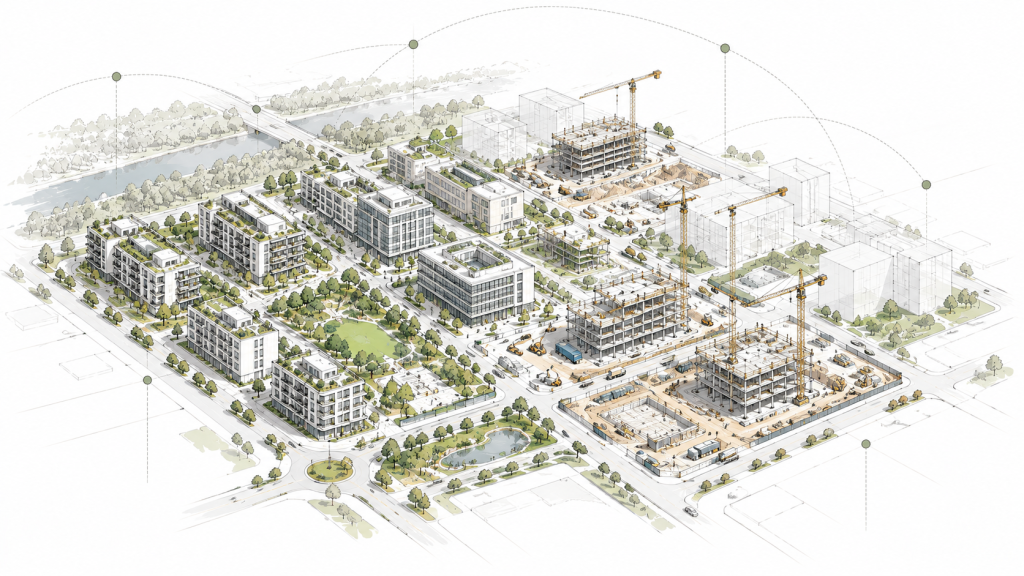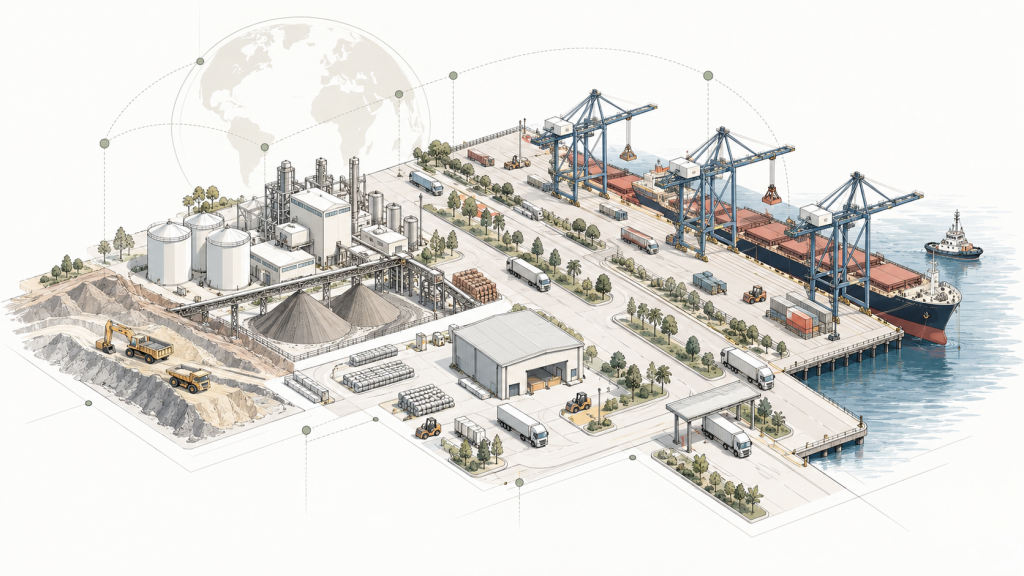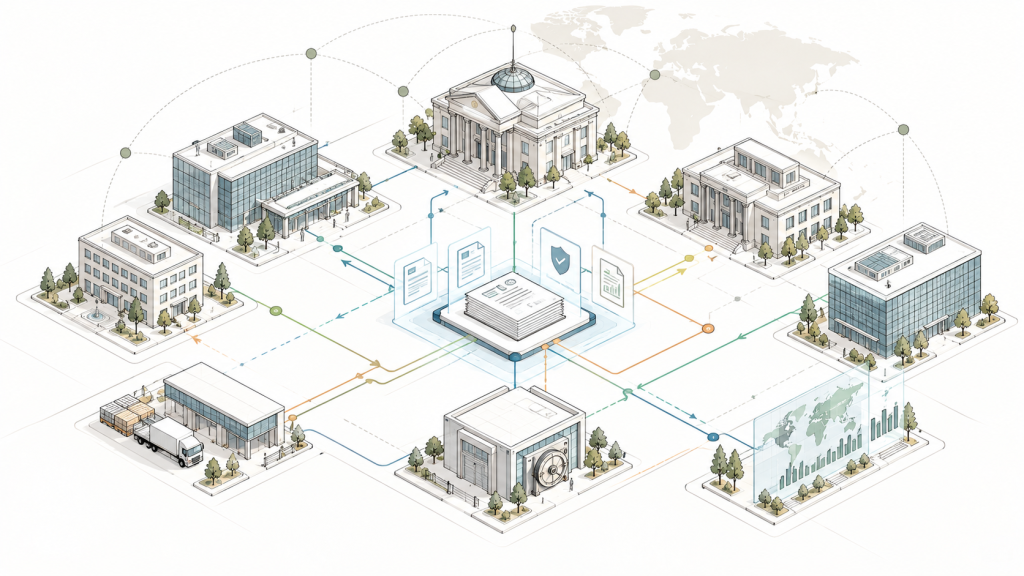
Real estate projects often begin with an opportunity: a site becomes available, a development concept emerges, or a market requirement creates the potential for a new residential, commercial or mixed-use project.
But identifying an opportunity is very different from establishing a viable development.
Between the initial concept and execution lies a complex combination of planning, market positioning, design, economics, financing, legal considerations and delivery strategy.
The earlier these elements are considered together, the greater the ability to identify risks, preserve flexibility and build a project capable of moving from concept to implementation.
A site is not yet a project
Land is naturally central to real estate development, but ownership or control of a site does not by itself establish development viability.
Its potential depends on numerous interconnected factors.
Planning regulations may determine what can be built. Physical characteristics and infrastructure may influence construction costs. Market conditions affect the type and scale of development that can realistically be absorbed. Financing requirements can determine how the project needs to be phased and structured.
A site should therefore be assessed not simply for what it is, but for what can realistically be developed, financed and delivered upon it.
This distinction is fundamental.
Start with the development fundamentals
Before detailed design begins, the fundamental parameters of the project need to be understood.
These may include location, land status, planning framework, accessibility, infrastructure, permitted uses, potential development density and environmental or technical constraints.
The intended market must also be considered.
A residential development, office project, hospitality scheme, healthcare facility or mixed-use development will each respond to different demand drivers and operational requirements.
Early-stage analysis should therefore establish the relationship between three fundamental questions:
What can be developed?
What does the market require?
What can be delivered economically?
A viable project emerges where these three dimensions can be aligned.
Market positioning shapes the project
Development decisions should not be driven solely by the theoretical capacity of a site.
The market ultimately determines whether the proposed product has a credible economic purpose.
Demand, pricing, rental levels, absorption capacity, competing developments and the requirements of future occupants or purchasers all influence the appropriate development strategy.
In international projects, this assessment can become more complex as demographic trends, institutional demand, public-sector requirements and broader economic development objectives may also influence the project.
Understanding these factors early helps avoid a common development risk: designing a technically feasible project for a market that does not require it in that form.
Design and economics must evolve together
Architectural ambition and financial viability cannot be considered independently.
The size, specification, density and configuration of a development directly influence construction costs, infrastructure requirements, operating economics and potential revenues.
For this reason, design should evolve alongside the financial model.
As the concept develops, assumptions relating to areas, construction costs, professional fees, infrastructure, contingencies, sales values, rental income and delivery schedules should be progressively tested.
This iterative process allows the development team to identify where adjustments may improve viability before significant costs or contractual commitments are incurred.
The objective is not simply to reduce cost.
It is to ensure that the design, commercial proposition and economic model support one another.
Financing should influence the development strategy
Financing is sometimes considered only once a project has been substantially designed.
For complex developments, this can be too late.
The anticipated financing structure may influence land acquisition, project phasing, pre-sales or pre-leasing requirements, equity contributions, debt capacity and the timing of construction expenditure.
Large projects may require several sources of capital or different financing mechanisms at different stages.
Understanding these constraints early allows the development strategy to be designed around a realistic capital pathway rather than attempting to finance a structure that has already become fixed.
The question is therefore not simply:
“How will the project be financed?”
It is also:
“How should the project be structured so that it can be financed?”
Phasing can transform project viability
Large developments do not necessarily need to be delivered as a single operation.
Phasing can provide an important mechanism for managing capital requirements, construction risk and market absorption.
An initial phase may establish infrastructure or generate early revenues. Subsequent phases can then respond to actual demand and evolving market conditions.
This approach can also create decision points at which assumptions are reassessed before additional capital is committed.
However, phasing needs to be incorporated into the project architecture from the outset.
Infrastructure, planning permissions, access, utilities and financing arrangements must remain compatible with the intended development sequence.
Well-designed phasing is therefore more than a construction schedule. It is a strategic component of the project's financial and operational structure.
Public and private stakeholders may need to align
Some international real estate developments sit within a broader economic or institutional context.
Projects may involve public authorities, municipalities, landowners, investors, developers, operators, financial partners and future institutional occupants.
Their objectives are not always identical.
Public stakeholders may focus on infrastructure, housing, employment or territorial development. Investors and financial partners require economic viability and appropriate risk allocation. Developers need a clear pathway through planning, construction and commercialisation.
Successful structuring requires these interests to be understood and, where possible, incorporated into a coherent project framework.
Clear roles and responsibilities become particularly important where public and private stakeholders participate in the same development ecosystem.
Risk is best addressed before execution
Real estate development inevitably involves uncertainty.
Planning conditions can change. Construction costs can evolve. Market demand may differ from initial assumptions. Financing conditions can move. Infrastructure requirements may become more extensive than anticipated.
Not every risk can be eliminated.
But many can be identified, assessed and allocated before they become execution problems.
Early-stage structuring creates the opportunity to test assumptions, examine alternative scenarios and establish appropriate contingencies while the project still retains flexibility.
The cost of changing a concept is generally far lower than the cost of changing a project already in execution.
From development concept to project architecture
At FCUBE SOLUTIONS Ltd, we approach real estate opportunities through the same fundamental principle applied to other complex projects: the individual components need to form part of a coherent architecture.
Land, planning, market demand, design, economics, financing and execution cannot be treated as isolated workstreams.
They influence one another.
Our role is to help analyse these relationships, structure practical development pathways and coordinate the expertise and counterparties required to move a project forward.
Where specialist legal, architectural, engineering, financial or other professional expertise is required, appropriate independent professionals can be incorporated into the project framework.
Building viability before building assets
Successful real estate development begins long before construction.
It begins with understanding the opportunity, testing its assumptions and creating alignment between what is physically possible, commercially relevant and financially sustainable.
A strong development concept should therefore answer more than:
“What can we build?”
It should answer:
“What should we build, for whom, under what economic structure, and through what execution pathway?”
That is where a development opportunity begins to become a viable project.
Important Notice
FCUBE SOLUTIONS Ltd is an international advisory and solution architecture company. It is not a bank, lender, broker, investment firm, financial institution, custodian or issuer/provider of financial instruments. FCUBE SOLUTIONS Ltd does not provide regulated investment or financial advice. Where a project requires regulated financial, legal, banking or other professional services, these are provided by appropriately authorised independent counterparties and professionals.
Content published in Insights is provided for general informational purposes only and does not constitute an offer, solicitation, investment recommendation or commitment to enter into any transaction.