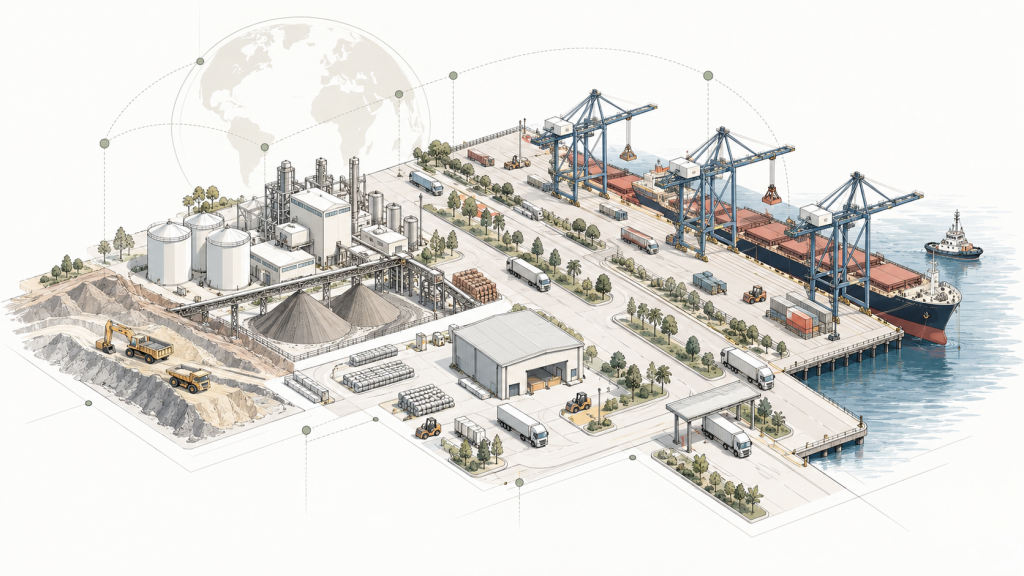
International commodity transactions often begin with what appears to be a straightforward opportunity: a seller has access to a product, a buyer has identified a requirement, and commercial terms appear capable of bringing the two parties together.
In practice, however, the distance between an opportunity and an executable transaction can be considerable.
Cross-border commodity transactions involve multiple layers of commercial, operational, financial and compliance considerations. Product specifications, origin, logistics, inspection, documentation, payment arrangements and counterparty capabilities must all form part of a coherent transaction structure.
The commodity itself is only one component of the transaction.
An opportunity is not yet a transaction
Early discussions frequently focus on three elements: product, quantity and price.
These are fundamental commercial parameters, but they do not establish whether a transaction can actually be executed.
A viable transaction requires a much broader understanding of the proposed operation. Questions must be addressed around the availability and control of the commodity, the identity and capacity of the counterparties, delivery obligations, inspection procedures, payment mechanisms and the documentary requirements supporting each stage.
Until these elements have been sufficiently defined, an apparent commercial opportunity remains just that: an opportunity.
Establishing the commercial architecture
The first stage of structuring is to understand precisely what each party is proposing and expecting.
This includes defining the commodity and its specifications, available volumes, delivery schedule, pricing methodology, Incoterms where applicable, origin and destination, and the responsibilities allocated to each participant.
These parameters must be internally consistent.
A commercially attractive price, for example, has limited relevance if the proposed logistics cannot support the required volumes or delivery schedule. Similarly, a buyer's stated requirement is insufficient if its purchasing process, payment capability or documentary expectations have not been established.
Effective structuring therefore begins by converting general commercial discussions into a clearly defined transaction architecture.
Counterparty capability matters
Commodity transactions can involve producers, mandate holders, traders, buyers, logistics providers, inspection companies, banks and other specialist counterparties.
Understanding who is actually responsible for each part of the transaction is essential.
The existence of multiple intermediaries does not necessarily invalidate an opportunity, but it increases the importance of establishing clear roles, authority and communication channels.
The relevant parties should be capable of demonstrating, as appropriate, their corporate standing, authority, operational capacity and ability to perform their respective obligations.
This is particularly important before commercially sensitive documentation or financial information is exchanged.
Logistics must be part of the structure
A commodity transaction cannot be considered independently from its physical execution.
Transport capacity, storage, loading and discharge arrangements, port infrastructure, customs requirements and delivery schedules may all determine whether the proposed transaction is viable.
Depending on the commodity and transaction structure, independent inspection may also play an important role in confirming quantity, quality or conformity at agreed stages.
These operational considerations should therefore be examined alongside the commercial terms rather than addressed only after an agreement has been reached.
The objective is to ensure that the contractual transaction reflects a realistic physical pathway from source to delivery.
Documentation creates the execution framework
Complex transactions generate documentation at several levels.
Corporate and compliance documents establish the identity and standing of the parties. Commercial documentation defines the transaction itself. Operational documents evidence the movement, inspection and delivery of the commodity. Banking or payment documentation supports the agreed financial settlement mechanism.
The precise documentation required will depend on the commodity, jurisdictions, counterparties and transaction structure.
What matters is that documents are introduced in a logical sequence and serve a defined purpose.
Requesting extensive documentation without first establishing the commercial architecture can create unnecessary exposure and confusion. Conversely, insufficient documentation can leave critical aspects of the transaction undefined.
The objective is not simply to accumulate documents, but to create a coherent documentary chain supporting execution.
Payment structures must reflect the underlying transaction
Payment is one of the most sensitive components of international commodity transactions.
Different transactions may involve different settlement structures depending on the parties, jurisdictions, commodity, contractual arrangements and banking requirements.
Whatever mechanism is contemplated, it should correspond to a genuine underlying commercial transaction and be compatible with the obligations of the parties.
Banking instruments or payment mechanisms should therefore be considered within the overall transaction architecture rather than treated as standalone solutions.
The commercial contract, logistics, documentary requirements and payment structure should support one another.
Compliance is an execution issue
Cross-border commodity transactions may involve multiple jurisdictions, banking systems and regulatory environments.
Counterparty due diligence, sanctions screening, source and origin considerations, anti-money laundering controls and other compliance requirements can therefore materially affect execution.
Compliance should not be viewed merely as an administrative step performed at the end of the process.
Potential issues identified late in a transaction can prevent banks, logistics providers or other professional counterparties from proceeding.
Integrating compliance considerations at an early stage helps determine whether the proposed structure is realistically executable before significant resources are committed.
Coordination becomes a critical capability
Even when the individual components of a transaction are valid, execution can fail if they are not properly coordinated.
The seller may be operationally ready while the buyer's procedures remain incomplete. Banking requirements may not correspond to the contractual sequence. Logistics may have been discussed without confirmation of the relevant delivery timetable.
Complexity therefore often arises not from any single component, but from the interaction between multiple participants and requirements.
Effective coordination establishes a common execution pathway, identifies dependencies and ensures that the relevant parties understand what must happen, by whom and in what sequence.
From commodity opportunity to transaction architecture
At FCUBE SOLUTIONS Ltd, we approach international commodity opportunities from a structuring perspective.
The objective is not simply to identify a buyer or seller. It is to understand whether the commercial opportunity can be transformed into a coherent and executable transaction.
This involves examining the underlying requirement, transaction architecture, counterparties, documentation, logistics, compliance environment and execution sequence.
Where specialist expertise is required, appropriate independent professional and operational counterparties can be incorporated into the structure.
The result is a more disciplined pathway between commercial opportunity and execution.
From opportunity to execution
Successful commodity transactions depend on alignment.
The commodity must correspond to a genuine requirement. The parties must be capable of performing. The logistics must support the contractual obligations. The documentation must reflect the transaction. The payment structure must correspond to the underlying commercial reality.
When these elements are considered together, complexity becomes manageable.
The central question therefore moves beyond:
“Is the commodity available?”
to the more important question:
“Can the complete transaction be structured and executed?”
That distinction is fundamental to the way FCUBE SOLUTIONS Ltd approaches complex international commodity transactions.
Important Notice
FCUBE SOLUTIONS Ltd is an international advisory and solution architecture company. It is not a bank, lender, broker, investment firm, financial institution, custodian or issuer/provider of financial instruments. FCUBE SOLUTIONS Ltd does not provide regulated investment or financial advice. Where a project requires regulated financial, legal, banking or other professional services, these are provided by appropriately authorised independent counterparties and professionals.
Content published in Insights is provided for general informational purposes only and does not constitute an offer, solicitation, investment recommendation or commitment to enter into any transaction.